How solar panels work in Scottish homes
Solar panels convert daylight into direct current electricity, an inverter turns it into usable alternating current for your home, and a battery stores surplus generation for the evening. This page walks through each component, how a system is sized for Scottish conditions, and the full installation sequence from survey to DNO notification.
A domestic solar photovoltaic (PV) system is straightforward in principle: panels on the roof turn daylight into electricity, an inverter makes that electricity usable in your home, and a battery stores any surplus for later. This page explains each component and then walks through the full installation sequence from first survey to switch-on and DNO notification.
The panels
Solar PV panels are made up of silicon cells. When daylight hits the cells, it knocks electrons loose, creating a flow of direct current (DC) electricity. The amount generated depends on the intensity of the light, the angle of the panel and the panel's efficiency. Modern monocrystalline panels are the standard for domestic installations because they deliver the highest output per square metre — important where roof space is limited. Panels keep working in overcast conditions; they simply produce less than on a bright day.
The inverter
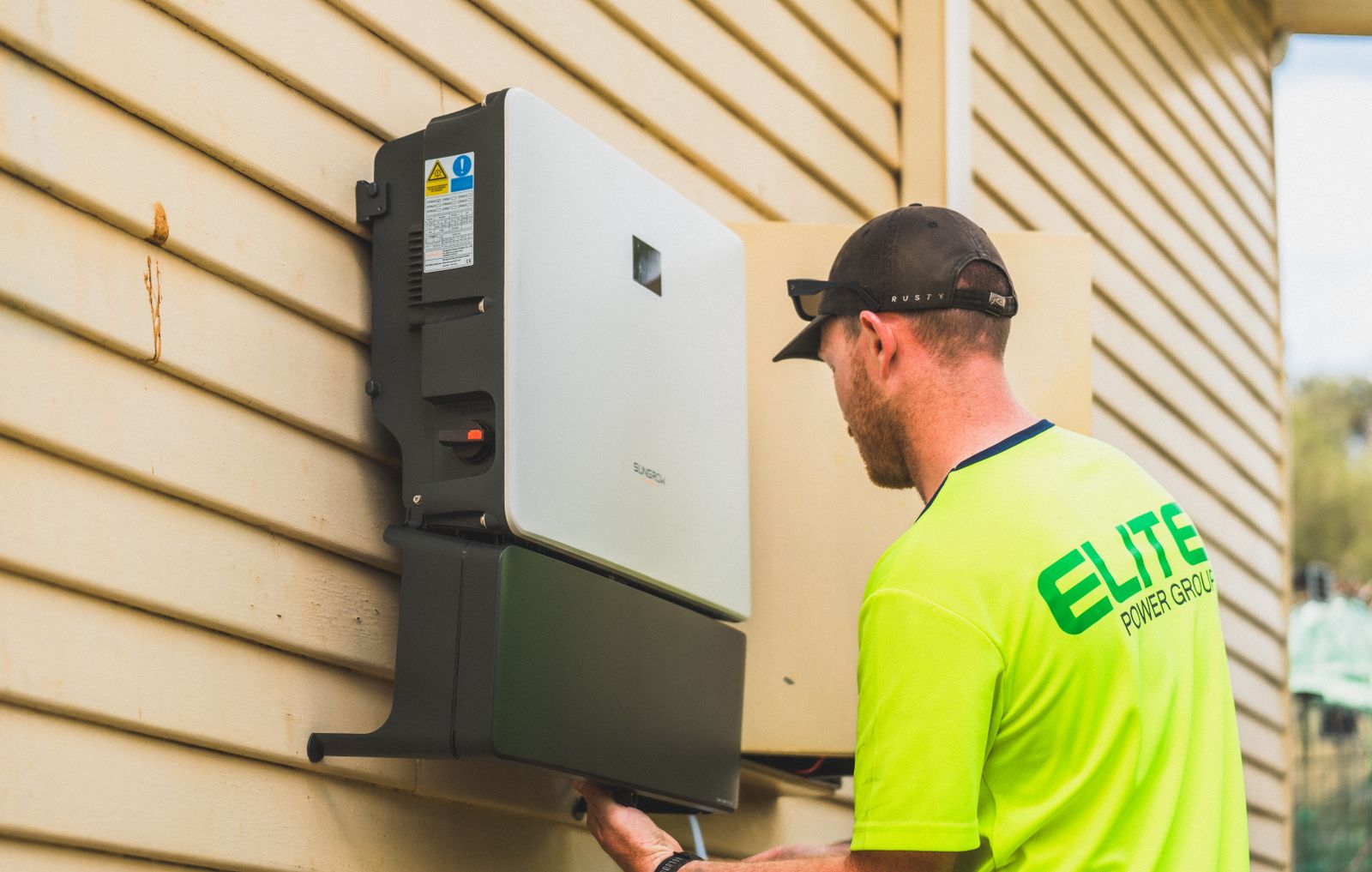
Your home runs on alternating current (AC), so the DC from the panels must be converted. That is the inverter's job. There are three common domestic setups:
- String inverter — a single box, usually mounted in a loft, garage or utility room, handling all the panels together. Simplest and most cost-effective for an unshaded, single-aspect roof.
- Micro-inverters — one small inverter under each panel. Each panel works independently, so shading on one panel does not drag down the whole array. Better for complex or partially shaded roofs.
- Power optimisers — a hybrid approach: a small optimiser on each panel conditions the output, then sends it to a central inverter. Good for shading, slightly cheaper than full micro-inverters.
The battery
Without a battery, any electricity you generate but do not use in the moment is exported to the grid. A battery captures that surplus and releases it in the evening and overnight, when your panels are not producing. Battery capacity is measured in kilowatt-hours (kWh). The right size depends on how much surplus your array produces and how much you use at night. A battery also lets you charge on a cheap overnight tariff and use that stored energy during the day. See our battery storage guide for more.
Roof orientation, pitch and shading
In Scotland, a south-facing roof pitched at around 30 to 40 degrees gives the highest annual generation. East and west-facing roofs are still very workable, each producing roughly 80% of a south roof's annual total, and a split east/west array spreads generation across more of the day. North-facing roofs are not recommended. Shading from chimneys, dormers, neighbouring buildings or trees has a real impact on output — a proper survey includes a shading reading so the system can be designed around it, with optimisers or micro-inverters where needed.
The DNO connection
Every grid-connected solar system must be registered with your regional Distribution Network Operator (DNO). For a standard domestic system up to 3.68kW per phase, your installer notifies the DNO after the installation under a "connect and notify" process — no prior application needed. For larger systems, or systems exporting significant surplus, prior DNO approval is required and can take several weeks. Your installer handles the paperwork either way, but it is worth confirming in your quote.
Installation steps
- Survey — a surveyor visits, measures the roof, takes a shading reading, checks the loft space for the inverter and confirms where the battery would sit. They look at your incoming supply and consumer unit.
- Quote and design — you receive a written quote with a full system specification, panel layout, inverter and battery details, warranties and a firm price with 0% VAT applied until 31 March 2027.
- Scaffold — scaffold is erected, usually the day before installation.
- Roof work — roof anchors and mounting rails are fixed, panels are clamped on, and the DC wiring is run to the inverter position.
- Inverter and battery — the inverter is mounted and connected, the battery (if included) is installed alongside, and the AC connection to your consumer unit is made.
- Commissioning — the system is tested, switched on and the generation meter is confirmed. The installer walks you through the monitoring app.
- DNO notification — the installer notifies your DNO of the connected system.
- Handover — you receive the handover pack: MCS certificate, warranties, electrical test certificates and user guide.
Ready to start?
If you would like a no-obligation survey and quote for a solar PV system — with or without a battery — fill in the form below or on our get a quote page. We arrange the survey through our MCS-certified partner at a time that suits you.
Related guides
Frequently asked questions
Do solar panels work on cloudy days in Scotland?
What does the inverter do?
How does the DNO connection work?
How long does installation take?
Last updated: 17 October 2026